
Skincare Regimen
How to Get Rid of Eczema Scars Naturally (and What Actually Works)
Mar
If you’ve been through a bad eczema flare-up, you know the frustrating results afterwards. The itch and redness finally calm down, but you’re left staring at dark patches, scratch marks, and rough skin that remind you of everything you just went through.
I hear this from customers all the time. “My eczema is gone but my skin still looks terrible.” Or, “Will these dark marks ever go away?”
The short answer? Yes, most of them will. And there’s a lot you can do to speed things up.
I’ve written before about the different types of eczema scars and what causes them. If you’re not sure whether what you’re seeing is post-inflammatory hyperpigmentation (dark patches), post-inflammatory erythema (pink/red patches), or actual scarring from deep scratching, that post breaks it all down.
This guide is about what to do next. What treatments and remedies can help fade those marks? From things you can try at home tonight, to professional options available here in Singapore (Disclaimer: I have no affiliation nor have I tried any of the professional options. I am just listing it here for reference).
First Thing: Is Your Eczema Actually Calm?
Before you try any scar-fading treatment, your skin needs to be in a stable state. No active flaring, no oozing, no cracking.
Why? Because most brightening or exfoliating ingredients, even gentle ones, can irritate compromised skin and trigger a new flare-up. That new flare creates new inflammation, which creates new dark marks. So it’s two steps forward, three steps back.
If your eczema is still active, focus on calming it first. Use your prescribed treatments, keep your daily skincare routine simple and gentle, and moisturise generously. The scar treatment can wait.
Natural Remedies That Help Fade Eczema Scars
Let’s go through the options and the science behind them. These are all things you can try at home.
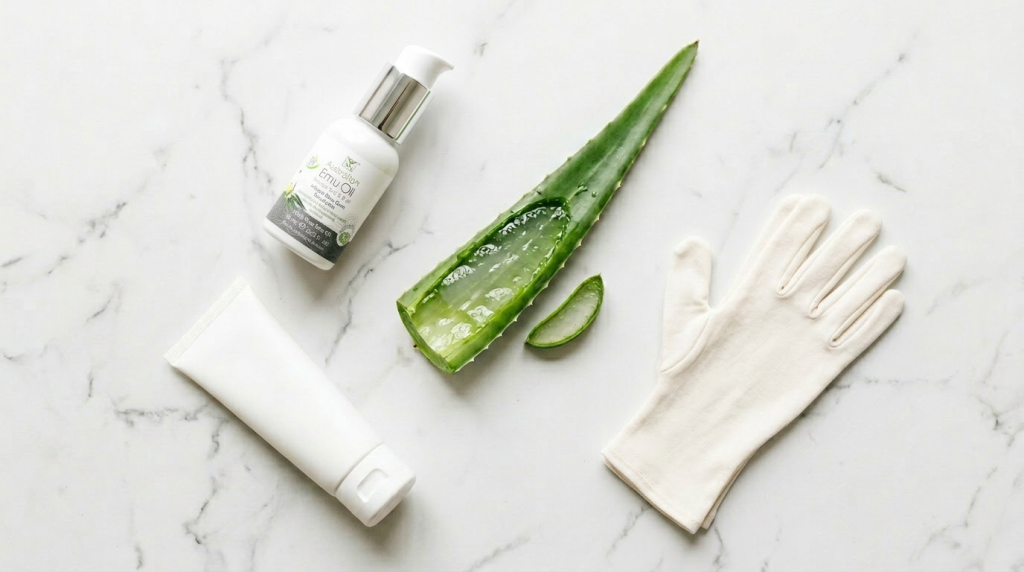
Emu Oil
I’m biased about this since we sell emu oil. But there’s a reason it’s our best-selling product and the one I personally rely on.
Emu oil works for eczema scars on multiple levels. It’s rich in omega-3 and omega-6 fatty acids that support skin repair and regeneration. It has anti-inflammatory properties that help calm residual redness. And unlike many oils, it penetrates deeply into the skin rather than just sitting on the surface, which means it actually reaches the damaged layers where healing happens.
I’ve seen customers with stubborn dark patches on their hands lighten significantly after a few weeks of consistent application. One customer’s thigh scars from topical steroid withdrawal went from very noticeable to barely visible.
How to use it: Apply a thin layer of pure emu oil to the scarred area twice a day. Once in the morning and once at night after your shower. A pea-sized amount goes a long way. Massage it in gently. Because emu oil absorbs quickly, it won’t leave you feeling greasy. Be consistent. You’ll typically start noticing a difference in 3 to 6 weeks, but deeper marks may take a few months.
For a detailed walkthrough, see our step-by-step guide to applying emu oil.
Customer story: Valerie’s hand eczema scars

Valerie*, a physiotherapy student in her 20s, had been battling hand eczema for three years. Steroid creams kept the flares in check but left her skin thin, cracked, and covered in dark marks. She felt embarrassed to hold her boyfriend’s hand, and dreaded showing her hands at school or during practice sessions.
After discovering emu oil through Skinshare, she applied it to her hands before bed and wore bamboo eczema gloves overnight. By the next morning, the dry, flaky skin on her fingers had improved significantly — even the redness had gone down.
After several weeks of regular use, Valerie’s hands no longer appeared dry, flaky, or discoloured. She stopped needing steroid creams entirely, with eczema only recurring on a single finger — easily managed with occasional emu oil.
“I was really taken aback because I’m usually a skeptic. But after I told my family about how it had worked for me, everyone wanted a hit of my emu oil.”
*Name changed for privacy
Aloe Vera
Aloe vera has been used for skin healing for centuries, and for good reason. It’s soothing, anti-inflammatory, and contains compounds that promote skin cell turnover. Which helps your body replace damaged, discoloured skin with new cells.
You can use fresh gel straight from the leaf (NTUC FairPrice usually sells large leaves for about $2), or if you prefer a packaged product, you can find commercial gels which are 99% pure aloe without the fragrance and chemicals you’ll find in most pharmacy brands.
Apply it to your scars after cleansing. If you keep the gel in the fridge, the cooling effect also helps with residual itch. I wrote more about using aloe vera for eczema here.
Niacinamide (Vitamin B3)
Niacinamide is a well-researched ingredient for fading dark marks. It works by reducing the transfer of pigment to your skin cells, which gradually evens out hyperpigmentation. It also strengthens the skin barrier — a bonus for eczema-prone skin.
Look for a serum or moisturiser with 4–5% niacinamide. This is widely available at Guardian, Watsons, or online. The reason I like niacinamide for eczema scars specifically is that it’s very well tolerated by sensitive skin. Unlike vitamin C or retinol, it rarely stings or irritates.
Start with once a day, in the evening. If your skin handles it well for two weeks, you can increase to twice daily. Stop if you notice any redness or flaring.
Vitamin C (Gentle Derivatives)
Vitamin C is a potent brightener, but pure ascorbic acid can be harsh on eczema-prone skin. Instead, look for gentler derivatives like sodium ascorbyl phosphate or ascorbyl glucoside. These convert to active vitamin C in the skin but are much less irritating.
A vitamin C serum can help with both dark patches (PIH) and redness (PIE). Apply to clean, dry skin in the morning, followed by your moisturiser and sunscreen. If you’ve never used it before, patch test on a small area first and wait 48 hours.
Rosehip Seed Oil
Rosehip oil is rich in vitamin A (retinoids) and essential fatty acids. Some studies suggest it helps improve skin texture and reduce pigmentation. It’s lightweight and generally well-tolerated.
You can mix a few drops into your moisturiser, or apply it on its own to scarred areas at night. Some of my customers alternate between emu oil in the morning and rosehip at night. Both are good; emu oil penetrates deeper, while rosehip sits closer to the surface and provides a different set of nutrients.
The One Thing Most People Forget: Sunscreen
UV exposure is the single biggest reason eczema scars stay dark or get darker.
Here’s what happens: your post-inflammatory hyperpigmentation already has excess melanin. When UV hits that melanin, it darkens further. So those brown patches that were slowly fading? One weekend of sun exposure without SPF can set you back weeks.
In Singapore, we get strong UV year-round, even on cloudy days. If you’re serious about fading scars, daily sunscreen is non-negotiable.
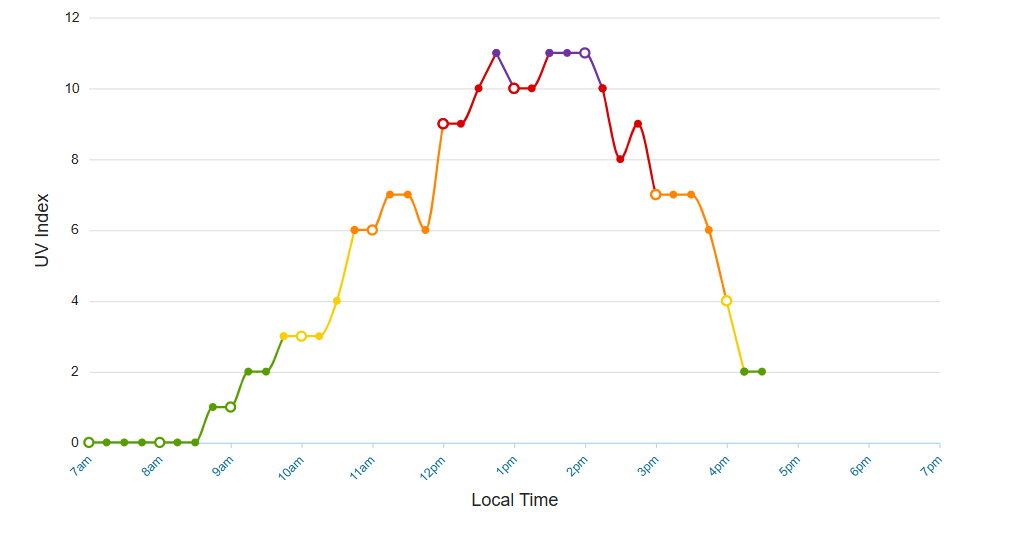
Use a mineral (physical) sunscreen with zinc oxide or titanium dioxide. These are less likely to irritate eczema skin compared to chemical filters. Apply SPF 30 or above every morning, and reapply if you’re sweating or spending extended time outdoors.
We stock the Wotnot Naturals Sunscreen SPF30 which is fragrance-free and formulated for sensitive skin. For babies and young children, there’s also the Wotnot Baby Sunscreen.
Stop New Scars from Forming: Break the Scratch Cycle
While you’re working on fading existing marks, you also want to prevent new ones from appearing. Every scratch during a flare-up creates fresh micro-damage and a new round of inflammation that can leave its own dark marks.
The most effective way to stop unconscious scratching, especially at night when you can’t control it, is to wear bamboo eczema gloves or arm sleeves to bed. It sounds simple, but I’ve had customers tell me this alone made the biggest difference. If you can’t scratch, you can’t create new marks.
Keep your nails short. Use cool compresses when the itch is intense. And moisturise before bed because dry skin itches more.
Professional Treatments Available in Singapore
If your scars are deep, textured, or haven’t responded to home care after several months, it may be worth discussing with a dermatologist. Below are some popular options for eczema scarring in Singapore. (Disclaimer: I have no affiliation nor have I tried any of the professional options. I am just listing it here for reference).
For dark patches (PIH)
Chemical peels — Light peels using glycolic acid or lactic acid can accelerate cell turnover and fade pigmentation. These are done in clinic. Typically you’d need a series of sessions spaced a few weeks apart. Let your dermatologist know about your eczema history so they can adjust the strength.
Laser treatments — Q-switched lasers and fractional lasers can target deep pigmentation. These are more aggressive (and more expensive) but can be effective for stubborn marks. Expect some downtime and make sure you go to a dermatologist experienced with eczema skin — the wrong settings can trigger a flare.
For redness (PIE)
Pulsed dye laser (PDL) — This targets the blood vessels causing persistent redness. It’s one of the more effective options for PIE that won’t resolve on its own. Multiple sessions may be needed.
For textured scars (atrophic or raised)
Microneedling — Creates controlled micro-injuries that stimulate collagen production. Good for shallow dents or uneven texture from chronic scratching. Not suitable for active eczema areas.
Steroid injections — For raised keloid or hypertrophic scars, your dermatologist may inject corticosteroids directly into the scar tissue to flatten it. But if you have gone through TSW, the thought of getting steroid injections may be a dealbreaker.
A few practical things to keep in mind: professional treatments in Singapore typically cost between $150–$500 per session depending on the type and area being treated. Most require multiple sessions. Always disclose your full eczema history to your doctor before any procedure.

What About Scar Removal Creams?
You’ll see plenty of “scar removal creams” marketed at pharmacies. Most contain silicone, onion extract (Mederma is a popular one), or a combination of brightening ingredients.
Are they effective? For true raised scars, silicone-based sheets or gels have some evidence behind them as they help flatten and soften scar tissue over time. For post-inflammatory dark patches, the brightening ingredients I’ve already mentioned above (niacinamide, vitamin C, emu oil) may do a better job than off-the-shelf scar creams.
Again, I don’t have experience with these creams. I would prefer to save money on the fancy scar creams and invest in consistent daily care instead. Using a good moisturiser, pure emu oil for the scars, and sunscreen. Boring, but effective.
How Long Will It Take?
This depends on your skin tone, the depth of the marks, how long the inflammation lasted, and how consistent you are with care.
As a general guide:
- Post-inflammatory redness (PIE): Usually fades within 3–12 months with anti-inflammatory care and sun protection.
- Post-inflammatory dark patches (PIH): Expect 3–24 months. Deeper pigmentation in darker skin tones takes longer. Consistent sunscreen use and gentle brighteners can speed this up significantly.
- Lichenification (thickened skin): Improves once the itch-scratch cycle stops. Can take weeks to months as the skin gradually softens and regenerates.
- True scars (atrophic, keloid): These usually need professional treatment and may not fully resolve, but they can be significantly improved.
The frustrating part is that progress is slow and gradual, so you won’t see dramatic change from one day to the next. Taking photos every 2–4 weeks can help you track improvement that’s hard to notice day-to-day.
A Simple Routine to Start Tonight
If you’re feeling overwhelmed by all the options above, here’s what I’d suggest as a starting point. You can always add more later.
- Morning: Gentle fragrance-free cleanser → Niacinamide serum (if tolerated) → Moisturiser → Mineral sunscreen SPF 30+
- Evening: Gentle cleanser → Pure emu oil on scarred areas → Moisturiser on top → Eczema gloves or sleeves for bed
Give it at least 4–6 weeks before judging results. Consistency matters more than which specific product you use.
Your Skin Can Heal
If you’re reading this, chances are you’ve already endured weeks or months of eczema misery — the itch, the sleepless nights, the self-consciousness. You deserve to feel good about your skin again.
Most eczema marks will fade. Some need a bit of help, some just need time and protection. Either way, it starts with treating your skin gently and being patient with the process.
If you have questions about which products might work for your specific situation, feel free to reach out via the chat button. I’m happy to help.
Products mentioned in this post:
- Y-Not Natural 100% Pure Emu Oil — our flagship oil for deep hydration and scar fading
- Wotnot Naturals Sunscreen SPF30 — mineral sunscreen safe for sensitive skin
- Adult Bamboo Eczema Gloves — prevent scratching and protect healing skin overnight
- Organic Cotton Arm Sleeves — full arm coverage for night-time protection
- Gloves in a Bottle Shielding Lotion — daily hand protection
