
News
“Rich people’s sickness”: Why the newest eczema treatments are out of reach for most Singaporeans
May
This morning, I read this CNA piece and one line stood out.
A 43-year-old talent manager named Chloe, profiled in the article, described eczema as “rich people kind of sickness”. She had spent over a decade cycling through oral steroids and immunosuppressants before a JAK inhibitor finally cleared most of her skin in 2021. The catch: it cost her around S$1,200 a month.
She has since switched to something more affordable.
If you’ve ever made that same calculation, weighing the expensive medicine that actually works against the cheaper one you can keep paying for indefinitely, you’ll know exactly what she meant. And I think that line deserves to sit at the centre of any conversation about eczema care in Singapore right now.
What changed in eczema treatment
For most of my adult life, the medical menu for severe eczema in Singapore was limited.
You had topical steroids of escalating potency. You had oral steroids in short bursts. You had older systemic immunosuppressants like cyclosporine (which I tried), methotrexate, and azathioprine, all of which work by broadly dampening the immune system, with side effects that can include high blood pressure, infection risk, and over the long term, a higher risk of certain cancers.
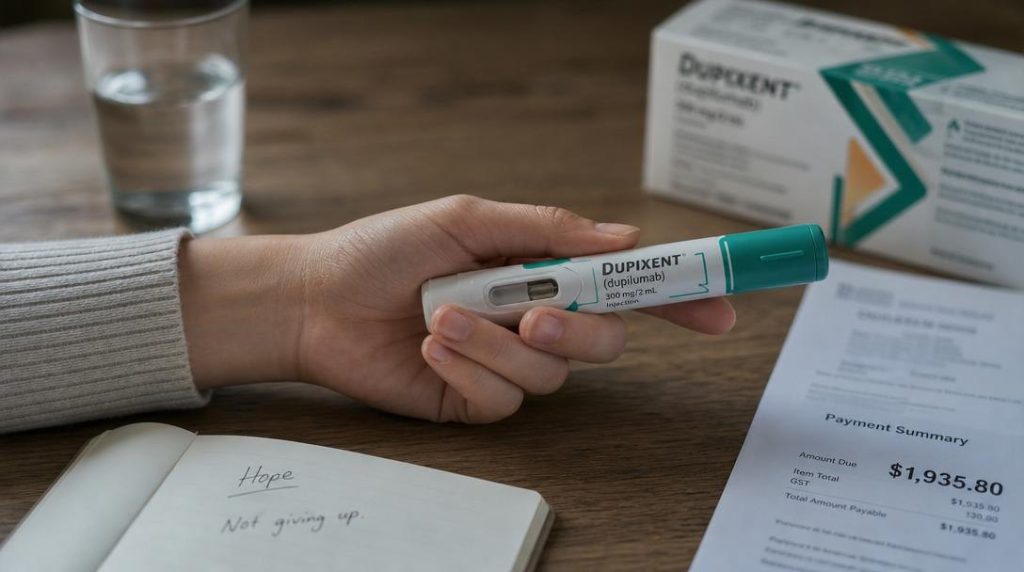
Then in 2019, Singapore approved its first biologic for moderate-to-severe atopic dermatitis. That was Dupixent (dupilumab). JAK inhibitors followed in the early 2020s.
These newer drugs target very specific parts of the immune system rather than suppressing it wholesale. Biologics are injections. JAK inhibitors are oral pills. They tend to work much faster than the older drugs, sometimes producing visible itch relief within days, and they have a more favourable safety profile than long-term immunosuppression.
For the roughly 20 per cent of eczema patients whose condition isn’t controlled by topicals and lifestyle changes, this is genuinely a different category of medicine. People who haven’t slept properly in years are suddenly sleeping. Children who refused to wear T-shirts because of their visible skin are wearing them again.
That’s the medical breakthrough.
But there’s a price.
The cost wall
A single Dupixent injection costs around S$900 at private clinics in Singapore. Maintenance dosing is once every two weeks. So that’s roughly S$1,800 a month, ongoing, for a treatment that doesn’t cure eczema and that most patients stay on for at least a year.
JAK inhibitors are similar in scale. According to the dermatologists quoted in the CNA piece, monthly costs range from about S$500 to S$2,000 depending on which one you’re prescribed and at what dose.
To put those numbers somewhere familiar: S$1,800 a month is more than what many Singaporean families spend on groceries in a month. It’s more than the median rent on a one-bedroom HDB flat. It’s the kind of figure that quietly redraws what’s possible in your life. Holidays you don’t take. Expenses you delay. Renovations you push back another year.
A 19-year-old polytechnic student in the article, Reyes, has been on Dupixent since January. The itch on his scalp stopped almost immediately. His sleep improved. He told CNA he was happy with the treatment, except for the price. That’s the part that always hits hard at the end.
The subsidy gap
Here’s where the Singapore-specific picture gets sharper.
In March 2024, abrocitinib — sold here as Cibinqo, one of the JAK inhibitors — was added to the Ministry of Health’s Medication Assistance Fund (MAF). Eligible Singaporeans can receive up to 75 per cent off, which brings the higher-dose pills down to between S$300 and S$900 a month, depending on household income. That’s still significant money, but it’s an order of magnitude more accessible.
Dupixent, on the other hand, is not subsidised in Singapore.
In November 2024, the then-Senior Minister of State for Health Dr Janil Puthucheary explained in parliament that Dupixent wasn’t recommended for subsidy because, at the price proposed by the manufacturer, the cost-benefit analysis didn’t add up. Cibinqo, by contrast, was assessed as at least as effective and was available at a lower price. So MAF backed Cibinqo and not Dupixent.
That’s a defensible policy decision. It’s also a brutal one if you’re a patient for whom Cibinqo isn’t suitable.
JAK inhibitors carry warnings about cardiovascular complications and blood clots. They’re often not recommended for older patients or people with certain comorbidities. For children under 12, only Dupixent and baricitinib are approved here. So if you’re a parent of a primary school-aged child with severe eczema and Dupixent works for them, your subsidised options are essentially nil.
The CNA piece tells the story of a father, identified only as Mr Quek, whose primary-school-aged son got a 75 per cent Dupixent subsidy through MediFund via a medical social worker. The improvement was immediate. Sleep returned. Confidence returned. Schoolwork improved.
The subsidy lasted 20 weeks.
After that, the family is back to weighing whether they can afford the next S$900 jab.

What this means if you’re not on biologics
Most of you aren’t on Dupixent or a JAK inhibitor. Most of you, like me, are managing things one tier below: with topicals, moisturisers, gentle washes, scratch prevention, dietary tweaks, and the occasional referral to a dermatologist when things get out of hand.
The CNA story might feel distant from where you sit. I’d argue it shouldn’t.
Three reasons.
First, the existence of these treatments changes what counts as the “ceiling” of eczema care. For decades, the ceiling was “your skin will probably always be partly inflamed and you’ll learn to live with it.” Now there’s a credible medical option above that ceiling, and the question of whether you reach it depends on income, insurance, and a sometimes-arbitrary subsidy decision. That’s a hopeful and meaningful change.
Second, eczema severity is not static. Many of us cycle between manageable years and brutal ones. If you ever cross into the moderate-to-severe band, this is the landscape waiting for you. Knowing the system before you’re inside it is useful.
Third, the things we can control, such as barrier repair, trigger avoidance, scratch prevention, sleep hygiene, gut health. All these become more important, not less, in a system where the next rung up costs S$1,800 a month. Every flare you prevent is a doctor’s visit you don’t make. Every night your child sleeps through is a step away from the conversation about systemic medication.
What still helps
I want to be clear. Nothing on Skinshare’s shop is a substitute for a JAK inhibitor or a biologic. If your dermatologist is recommending one, that conversation is between you and them, and it should be guided by clinical evidence and your own circumstances.
What our products can do is run alongside whatever medical treatment you’re on, and reduce how often you need to climb the ladder.
The supportive care that has the strongest evidence behind it tends to be unsexy: a gentle, fragrance-free wash instead of soap, a barrier-repair moisturiser applied liberally and often, an ointment for cracked patches before they get infected, scratch prevention at night so your nervous system can finally stop fighting itself, and an honest look at the foods, stressors, and environmental triggers that send you into flares.
None of this makes for a CNA headline. It also doesn’t cost S$1,800 a month, and it works for a meaningful portion of the eczema population, particularly when it’s started early and applied consistently.
If you’re already on biologics or JAK inhibitors, the dermatologists in the CNA piece are clear that you still need this layer too. The newer drugs reduce inflammation. They don’t replace moisturising, trigger avoidance, or itch control.
Your story matters more than you think
The CNA article ends on a quiet, devastating note. A woman who runs an eczema support group on Facebook says members often ask about biologics and JAK inhibitors. The thread usually goes silent. Only a small fraction of people can afford to try them.
This is the kind of gap that doesn’t show up in clinical trial data. It shows up in private group chats, in late-night searches at 2am, in the resignation in someone’s voice when they tell their dermatologist “I’ll just stick with what we had before.”
It’s also why we’ve been running the Hidden Burden of Adult Eczema survey. The point of the survey is to put numbers and stories around what living with eczema in Singapore actually looks like in 2026, beyond what any single CNA piece can capture. How much you spend out of pocket. How much sleep you’ve lost. How many work days. How much it shows up in your relationships, your career, your sense of yourself.
If you haven’t filled it in yet, please do. It takes about ten minutes, it’s anonymous, and three respondents who leave their email at the end will get a SGD20 discount code. More importantly, the more of us who answer, the harder it gets to argue that this is a niche cosmetic complaint that doesn’t deserve broader subsidy reform.
