When a parent messages Skinshare for advice about their child’s eczema, I would always go through a quick checklist of environmental factors. “It might be the dust, or a new cleaning product you started using, or whether they stay in aircon 24/7.”
And as of last week, another big study was published that added more evidence to the pile.
A research team in Tianjin and Uppsala just published a paper in the Journal of Exposure Science & Environmental Epidemiology showing that the materials inside our homes, and the chemical products we keep in our cupboards, have a link to asthma, rhinitis and eczema in children. Importantly, they found these effects even when the child wasn’t the one using the products.
Let’s take a look at what that study found, what 20 years of earlier research already showed, and what it means for you and your little one.
Eczema, asthma and rhinitis are siblings, not strangers
Most of us think of eczema as a skin problem, asthma as a lung problem, and allergic rhinitis (the constant sneezing, the blocked nose every morning) as a nose problem. Three different doctors, three different prescriptions, three different treatments.
But immunologists have spent the last decade making a stronger and stronger case that these three conditions are branches of the same atopic tree. They share an underlying biology: a leaky epithelial barrier (whether that barrier is skin, airway lining or nasal lining), an overactive immune response, and a tendency to flare in response to the same triggers.
This is sometimes called the “atopic march.” Eczema in infancy often comes first, then food allergies, then asthma, then rhinitis. Many Singaporean families know this pattern intimately. The same child who had baby eczema at six months ends up with the inhaler in primary school.
It means a single household exposure can plausibly aggravate all three conditions at once. And if you address the triggers for one of them, it tends to help improve the other conditions too. Then you can break the itch-scratch cycle.
What the study found
The new paper, by Yuxuan Zhao and colleagues from Tianjin University and Uppsala University, looked at Chinese children and examined whether the building materials inside their homes (flooring, window frames, wall coverings) relate to whether the children currently have asthma, wheeze, rhinitis or eczema. And whether the chemical products inside their homes (cosmetics, hair-care products, cleaning products) do the same.
Three findings stood out:
Laminated wood flooring was associated with current rhinitis. Children whose homes had laminated wood floors had 1.7 times the odds of having current rhinitis. Laminated and engineered wood flooring is a known source of formaldehyde and total volatile organic compounds (TVOCs), which off-gas into the air, especially when new.
Hair-care products in the home were associated with current eczema in children, with about twice the odds. The cumulative number of cosmetics in the home also tracked with wheeze in a dose-response way (more products, more wheeze).
The authors also made an interesting point: these effects held even though the children themselves were not necessarily the direct users. In other words, a parent’s leave-on hair product, a sister’s collection of perfumes, the floor finish in the living room: all of these can shape the indoor air the child breathes 12 to 16 hours a day.
It’s a cross-sectional questionnaire study, so it can show association but not prove causation. The effect sizes are modest. But the signals match what other groups have been finding in Sweden, the US, the UK, Korea, Canada and Japan for nearly two decades.
Two decades of converging evidence
If we look at research that goes further back, there are patterns that keep showing up:
PVC and vinyl flooring. Swedish researchers have conducted studies with thousands of children since the early 2000s. Children with PVC flooring in their bedroom were about 1.5 times more likely to develop doctor-diagnosed asthma over 10 years. When PVC was in the parents’ bedroom (which is a proxy for prenatal exposure), the risk roughly doubled, suggesting that pregnancy is a particularly sensitive window.
Renovation in pregnancy and early childhood.The China-Children-Homes-Health programme, which surveyed close to 40,000 children, found that solid wood and laminated flooring, oil-paint walls, new furniture and recent renovation (especially during pregnancy) were linked to higher rates of asthma, wheeze and eczema. A separate Chinese study found that pregnancy renovation raised the odds of childhood rhinitis onset by a factor of two and eczema onset by almost five.
Phthalates from PVC and consumer products. Phthalates are plasticisers used in vinyl, fragrances and many personal-care products. A New York birth cohort found that mothers with the highest urinary butylbenzyl phthalate (BBzP) in pregnancy had children with a 52% higher risk of early-onset eczema by 24 months. A follow-up showed the same prenatal phthalates raised asthma risk at age 5 to 11 by nearly 80%. A Taiwanese study found a five-fold increase in wheeze in boys whose mothers had high prenatal phthalate exposure.
Cleaning products and scented sprays.A UK cohort of more than 7,000 mother-child pairs found that mothers in the top 10% for prenatal household chemical use had children more than twice as likely to wheeze persistently by age three and a half. A Canadian birth cohort found that frequent cleaning-product use in the first three to four months of life raised the odds of recurrent wheeze, atopy and asthma by age three. Scented sprays, plug-in air fresheners, dusting sprays, antimicrobial hand sanitisers and oven cleaners came out as the worst offenders.
Formaldehyde and VOCs.A Korean panel study with real-time indoor formaldehyde sensors found that higher formaldehyde levels tracked with worse atopic dermatitis symptoms. The same team’s chamber work showed that just four hours of formaldehyde exposure significantly increased water loss through the skin in eczema patients. That’s a direct measurement of skin-barrier damage from a chemical many of us have living quietly in our walls and furniture.
The European Respiratory Society reviewed 53 studies and concluded that aromatics (benzene, toluene, xylene), formaldehyde and certain solvents may play a harmful role in the development and exacerbation of asthma and allergy.
How do these indoor chemicals actually trigger eczema?
Formaldehyde, which off-gasses from new MDF, particleboard, laminate floors, vinyl wallpaper adhesives and some interior paints, has been shown to directly increase water loss through eczema-prone skin within four hours of exposure.
Phthalates and certain VOCs nudge the developing immune system towards a Th2 (allergic) phenotype. This has been shown in animal experiments and replicated in human cohort data, including measurements of cord blood.
Once the barrier is leaky, Staphylococcus aureus (the bacterium that loves to colonise eczema skin) gets a foothold, and you’re into a cycle of inflammation, infection and itch. If you’ve ever wondered why your child’s eczema flares with a yellow crust, this is the staph story.
Put plainly: every time you damage a barrier, you make it easier for the next thing to set off a flare. That’s why parents often describe a tipping point, where one new exposure (the renovation, the new helper, the new detergent, the move to a colder air-conditioned room) seems to “break” their child’s skin.
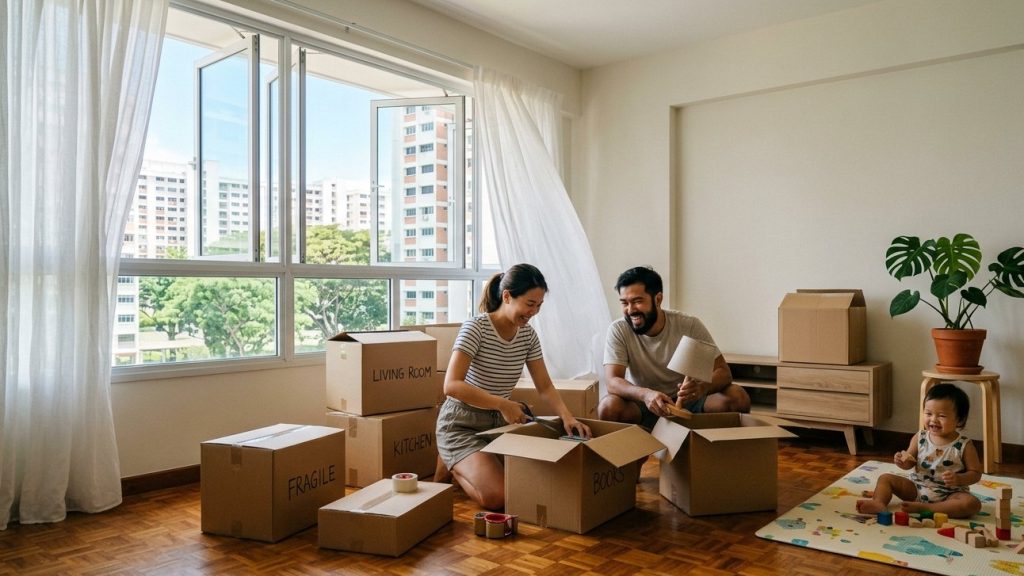
Above: Changes to the living environment can be linked to childhood eczema
How living conditions in Singapore might be contributing to your child’s eczema
Our living spaces are sealed and air-conditioned for hours at a stretch.Research from local child-care centres has shown that air-conditioned, mechanically ventilated rooms tend to have lower air-change rates and higher levels of occupant-derived pollutants. Naturally ventilated rooms had lower asthma and allergy symptoms in children, even though they let in more outdoor PM2.5. Air-conditioning is a double-edged sword. It keeps outdoor pollution out, but it also seals indoor pollutants in.
Our renovations stack up the same VOC-emitting materials. A typical post-reno BTO or condo combines new laminate flooring, MDF or particleboard built-in carpentry, vinyl wallpaper adhesives, oil-based primers and freshly painted walls. These are exactly the materials that off-gas formaldehyde and TVOCs. NEA has actually mandated formaldehyde-free interior paints in Singapore from 2026, which is a useful regulatory tailwind.
Our humidity is a dust-mite paradise.The dominant local mite is Blomia tropicalis, with Dermatophagoides pteronyssinus a distant second. Singapore studies have found that all sofas and carpets surveyed exceeded 500 mites per gram of dust. If you’re not sure whether dust mites are part of your child’s flare picture, the symptoms checklist I wrote a while ago is still a useful place to start.
CASE STUDY: Siti, a Sengkang mum, contacted me when her 18-month-old daughter developed eczema patches on her chin and arm folds. The clinic had prescribed two different steroid creams, but Siti was nervous about putting steroids on her baby’s face. Once we shifted her routine to a gentle, fragrance-free wash, a clean cream and a thin layer of emu oil at night, her baby’s skin improved within three days.
What you don’t notice is how much of your routine can quietly pile up the chemical load on your child: scented baby wipes, an aggressive antibacterial body wash, a fabric softener. None of this is unusual. But all of it was adding stress to already-vulnerable skin.
Six low-cost things you can actually do at home
The point of all this isn’t to make you feel guilty about your renovation, your shampoo or your air-con. It’s to give you a small set of tweaks that the evidence suggests are worth doing. None of these are guaranteed cures. They’re risk-reducers.
1. Let a new home or renovation off-gas before you move in.A Chinese field study showed that vacancy time after renovation, the number of new furniture pieces, and the choice of materials each significantly affected indoor formaldehyde, xylene and TVOC levels. One to two weeks of active airing is a common Singapore recommendation. If you have a baby or a child with eczema or asthma, lean towards the longer end. Run the windows wide open. Run a fan. Be patient.
2. Choose lower-VOC and formaldehyde-friendly finishes where you can. From 2026, NEA has mandated formaldehyde-free interior paints. Some flooring brands now publish their formaldehyde-emission ratings. You don’t have to overhaul the whole reno. Even just choosing a low-VOC paint for your child’s bedroom is a meaningful change.
3. Ventilate, even when the air-con is on. I know nobody wants to crack the windows open in March. But running the AC 24/7 with the windows shut means whatever your home is off-gassing, you’re rebreathing. A practical compromise is to open the windows wide for 10 to 15 minutes in the early morning and late evening, when traffic and ambient pollution are lower. Then shut up and aircon as usual.
5. Be cautious with personal-care products in pregnancy and infancy. This is where the new 2026 finding lands hardest. Hair-care products at home were linked to eczema in children even when the children weren’t the users. Phthalates, parabens and synthetic fragrances are common ingredients across cosmetics, perfumes, leave-in hair products and air fresheners. You don’t have to throw everything out. Just consider which products spend hours on your skin or hair (and therefore hours diffusing into the air around your child), and look for fragrance-free or low-fragrance alternatives.
6. Manage humidity and dust mites. Indoor humidity in the 40 to 60% band slows formaldehyde off-gassing and limits dust-mite growth. A dehumidifier in the air-conditioned bedroom, or simply running the AC on dry mode for part of the day, can help. If house-dust mites are part of your child’s flare picture, encasing the mattress and pillow in a properly woven anti-dust-mite cover is one of the highest-yield interventions for the lowest ongoing effort.
Despite many published research papers, we cannot assume that just doing the above will solve our eczema problems. These studies are mostly cross-sectional or cohort observational studies, with effect sizes typically in the range of 1.2 to 2.5 times the baseline odds. That’s a meaningful nudge, not a deterministic cause. The European Respiratory Society reviewers themselves called the indoor-VOC evidence base “weak” overall, while still concluding it was strong enough to support sensible mitigation.
The dominant drivers of childhood eczema in Singapore continue to be genetics (filaggrin and family history of atopy), house-dust-mite sensitisation, antibiotic use in pregnancy and birth-related factors. Indoor chemical exposures are additional modifiable risks. They aren’t the whole story.
Don’t beat yourself up if you can’t change every variable. Pick the two or three that are easiest in your situation. The aim is risk-reduction across the family’s airways, nose and skin together, not a perfect house.
So where does this leave us?
If I had to compress this whole post into one paragraph, it would be this. Eczema isn’t a skin problem in isolation. It’s part of a wider atopic story that also shows up as wheezing, blocked noses, and allergies to dust mites and pollens. The home environment we build around our children, the materials, the cleaning cupboard, the fragranced products on the shelf, plays a real, measurable, and increasingly well-understood role in that story. None of it determines anyone’s outcome. But small, consistent indoor choices add up, and the evidence keeps pointing in the same direction.
If you’ve been asking, “Could it be the new house?”, the honest answer is: it might genuinely be part of it. And there are things you can do about that.
As always, drop me a message if you’d like help working out a routine for your little one. Just hit the WhatsApp button in the bottom right corner.
References
Zhao Y, Norbäck D, Hou J, Knutz M, Sun Y. Indoor building materials and household chemical products in Chinese homes are associated with current asthma and allergic symptoms in children. J Expo Sci Environ Epidemiol, 2026. Link
Shu H, Bornehag CG, et al. PVC flooring at home and development of asthma. 10-year DBH follow-up, 2014. Link
Zhang Y, Sun Y, Norbäck D, et al. CCHH renovation and atopic disease. Environ Int, 2018. Link
Norbäck D, et al. Redecoration in pregnancy and childhood atopic disease (Taiyuan). 2021. Link
Just AC, Whyatt RM, et al. Prenatal BBzP and early eczema. Columbia CCCEH, 2012. Link
Whyatt RM, Perzanowski MS, et al. Prenatal phthalates and childhood asthma. Columbia CCCEH, 2014. Link
Ku HY, Wang PW, et al. Prenatal phthalates and wheeze in Taiwanese boys. PLOS ONE, 2015. Link
Sherriff A, Farrow A, Golding J, Henderson J. ALSPAC: prenatal household chemicals and persistent wheeze. 2005. Link
Parks J, Takaro TK, et al. CHILD cohort: cleaning products in infancy and asthma. CMAJ, 2020. Link
Han I, et al. Indoor formaldehyde and atopic dermatitis in Korean children. Allergy Asthma Immunol Res, 2021. Link
Nurmatov UB, et al. Volatile organic compounds and risk of asthma and allergy: a systematic review. Eur Respir Rev, 2015. Link
Akdis CA. The epithelial barrier hypothesis. Nat Rev Immunol, 2021. Link
Wang Y, et al. Residential decoration, indoor air and child respiratory disease in Chongqing. Indoor Built Environ, 2024. Link
Skin Research Institute of Singapore. Atopic Dermatitis Programme.Link
KK Women’s and Children’s Hospital. Paediatric Dermatology.Link
Zuraimi MS, Tham KW, Chew FT, Ooi PL. Ventilation and asthma/allergy in Singapore child-care centres. Indoor Air, 2007. Link
Sultan ZM, Pantelic J, Tham KW. PM2.5 in Singapore daycare classrooms. Indoor Air, 2020. Link
House-dust-mite species composition in Singapore homes (Blomia tropicalis predominant).Link
Suaini NHA, Yap GC, Tham EH, et al. GUSTO: atopic dermatitis trajectories in Singapore children. 2021. Link
Lau HX, et al. Comparing early-life eczema in Shanghai and Singapore Chinese children. Clin Exp Allergy, 2025. Link
Olsson M, Bajpai R, Wee LWY, et al. Cost of childhood atopic dermatitis in Singapore. 2020. Link
NEA formaldehyde-free interior paint mandate (Singapore, 2026): industry summary. Link
I am the founder of Skinshare.sg. I developed eczema over 20 years ago, and went through topical steroid withdrawal 10 years ago. Now I am a certified nutrition therapist, providing skincare advice and curating suitable products for others to manage their eczema.