
Cream, Skincare Regimen, Soap/Cleanser/Bath
Can Haze Trigger a Flare-Up?

Oct
Has your skin felt hotter, tighter and itchier this past week, even though you haven’t changed a thing in your routine? Maybe your neck, your arms or the backs of your hands started prickling on the walk from the MRT, and by evening you were scratching without noticing.
If so, you’re not imagining it. On 9 October, the 24-hour PSI reached 135 to 192 across Singapore, well into the Unhealthy range, as smoke drifted over from fires in Sumatra and Kalimantan. Most of the haze advice we hear is about our lungs and eyes, and rightly so. But skin is the organ that sits in that air all day, and for anyone with eczema or TSW, it often reacts first.
I get messages every haze season asking the same thing: can haze really trigger a flare-up? The short answer is yes, it can. Here’s what haze is actually made of, what it does to skin, and the routine I recommend to protect yours until the air clears.
What Is Haze Actually Made Of?
Haze is smoke. The haze that reaches Singapore comes mostly from land and forest fires in the region, and peat fires are the worst offenders because peat smoulders slowly and releases huge amounts of smoke.
According to the National Environment Agency, the main pollutant during transboundary haze is PM2.5: fine particles 2.5 micrometres across or smaller. That’s around 30 times thinner than a strand of hair. These particles are mostly burnt organic matter (carbon), and they carry other things on their surface, including chemicals called polycyclic aromatic hydrocarbons (PAHs) and traces of metals. Alongside the particles come gases like carbon monoxide, plus the larger PM10 particles you can see as that grey, smoky film in the air.
So when haze settles on your skin, it isn’t just “dust”. It’s a fine layer of tiny particles carrying a mix of chemicals your skin has to deal with.
What Haze Does to Your Skin
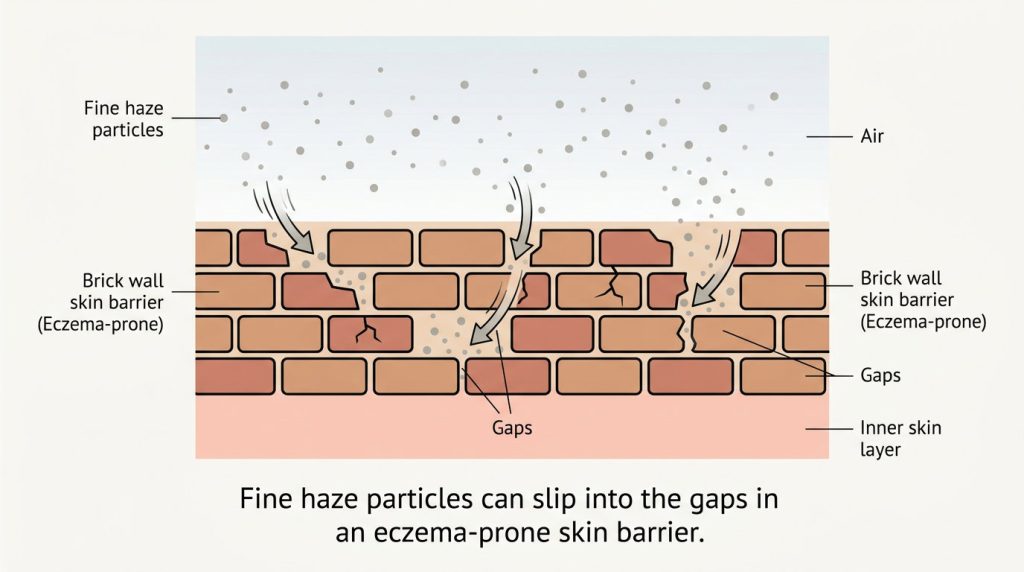
Healthy skin has a fairly tough outer layer. Think of it as a brick wall: skin cells are the bricks and natural fats are the mortar. Eczema skin already has gaps in that wall, which is why it loses moisture faster and lets irritants in more easily.
Research on air pollution and skin points to a few things happening when fine particles land on that wall:
They weaken the barrier further. Studies summarised in this 2023 review on air pollution and atopic dermatitis found that particulate matter lowers levels of the structural proteins that hold the skin barrier together, including filaggrin, a protein many people with eczema are already short of.
They create oxidative stress. Pollutants generate unstable molecules (free radicals) that damage the fats and proteins in the outer skin layer. Eczema skin appears to be more vulnerable to this kind of damage than healthy skin.
They switch on inflammation and itch. The PAHs carried on haze particles activate a sensor in skin cells called the aryl hydrocarbon receptor. In lab studies, this pathway increases a molecule called artemin, which makes nerves in the skin more sensitive to itch. That may explain why haze itch can feel so out of proportion to what you can see on your skin.
Why Haze Can Tip Eczema Into a Flare-Up
This isn’t only lab theory. A 2024 study of more than 1.4 million eczema consultations at the National Skin Centre between 2009 and 2019 found that in weeks when PM2.5 levels were higher, atopic dermatitis visits rose by about 10%. (The researchers noted that visits dipped again at the very highest pollution levels, most likely because people stayed indoors or cancelled appointments.) Similarly, when wildfire smoke blanketed San Francisco in 2018, clinics there saw more patients with eczema and itch within weeks.
These studies show an association, not proof that haze alone causes flares. But in real life, haze rarely comes alone. In our community, I see the same pile-up every haze season:
Heat and sweat. Haze often arrives in hot, dry spells. Sweat mixes with the particles on your skin, and sweat on its own is already a common eczema trigger in Singapore. (I wrote about this in my post on high heat stress days.)
Shut windows and aircon all day. Staying indoors is the right call for your lungs, but hours in air-conditioning dry the skin out, which lowers the threshold for a flare.
Unconscious scratching. Itchy skin gets scratched, scratched skin breaks, and broken skin lets in even more irritants. This is how a mild haze itch turns into a proper flare-up over a few days.
Stress and poor sleep. Haze season disrupts routines: no outdoor exercise, kids stuck at home, worry about family members with asthma. Stress and broken sleep are well-known flare triggers in their own right.
If you want a fuller picture of how triggers stack up, my guide on why eczema flare-ups happen goes through them in more detail.

What to Do on Haze Days: A Simple Three-Step Routine
You can’t control the PSI, but you can reduce how much haze actually sits on your skin and how quickly you respond when it starts to itch. The order is simple: shield, rinse, soothe.
Step 1: Shield Your Skin Before You Head Out
This is the step most people skip, and it makes a big difference.
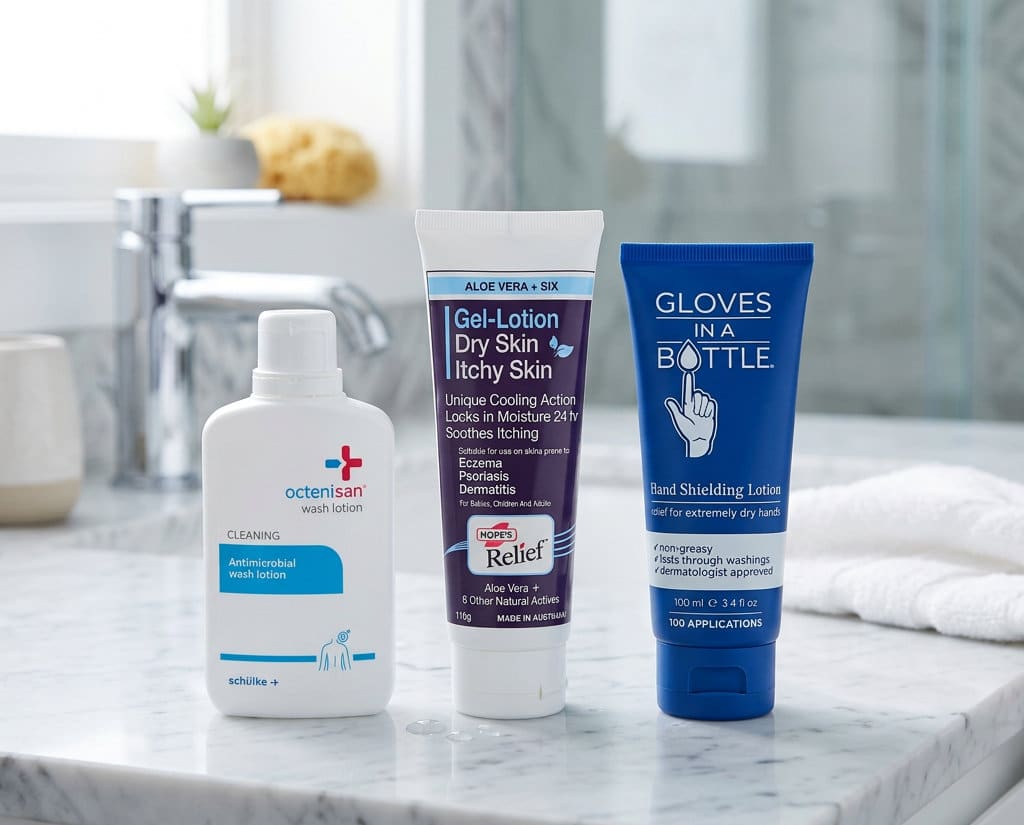
Before you leave the house, apply Gloves in a Bottle to your whole body, not just your hands. Pay attention to the areas that are exposed or that tend to flare: face and neck, arms, the backs of your hands, calves and ankles. Gloves in a Bottle is a shielding lotion. It bonds with the outer layer of dead skin cells to form an invisible protective layer that helps your skin hold on to its own moisture and keeps irritants from settling directly on it. On haze days, that means fine particles land on the shield rather than straight onto your skin.
Unlike a regular moisturiser, it doesn’t wash off easily; it wears off gradually as your skin naturally sheds. Reapply every four to six hours while the haze lasts, and again after a shower.
For the face, I prefer Gloves in a Bottle Botanical. It works the same way but is formulated to be extra lightweight and gentle for sensitive skin, with aloe vera, chamomile, arnica, comfrey, yarrow and vitamin E.
Just know that Gloves in a Bottle is a protective layer, not an air filter, so it reduces contact with haze rather than blocking it completely. And the Botanical version contains chamomile, arnica and yarrow, which belong to the daisy plant family. If you know you react to daisy-family plants, patch test on a small area first, or stick to the original formula.
Step 2: If the Itch or Redness Starts, Rinse It Off Quickly
If you’ve been outdoors and your skin starts to itch, prickle or turn red, don’t wait it out. The longer haze particles and sweat sit on irritated skin, the more chance they have to work their way in.
Rinse off as soon as you can with plain, lukewarm water. Not hot: hot water strips the skin’s natural oils and makes the itch worse afterwards. Pat dry with a soft towel; don’t rub.
If your skin is already flaring, scratched or broken, use Octenisan Wash Lotion instead of your usual soap or shower gel. It’s a gentle antimicrobial wash with a skin-neutral pH, free from artificial colours and perfume, and it’s well tolerated by people going through TSW. Apply it undiluted to wet skin (or a damp facecloth), leave it on for about a minute, then rinse off thoroughly. Scratched skin is an open door for bacteria, so this matters most once the skin barrier has been broken.
One important limit: Octenisan is not for children under the age of 3. For babies and toddlers, stick to plain lukewarm water and ask your doctor what to use if the skin is broken.
Step 3: Soothe the Itch
Once your skin is clean and patted dry, calm the itch before it turns into a scratching cycle.
I like Hope’s Relief Premium Gel-Lotion for this. It’s a hybrid of a gel and a lotion, so it feels instantly cooling on hot, irritated skin while still moisturising. It’s steroid-free and has no artificial fragrance, and it’s made with aloe vera, sea buckthorn, calendula, chamomile, marshmallow root, vitamin B5 and glycerin. Here’s something that catches a lot of people off guard: keep it in the fridge. Applied cold, it soothes even faster, which makes it especially handy for kids who can’t stop scratching.
Like the Botanical lotion, it contains calendula and chamomile, so patch test first if you’re sensitive to daisy-family plants. It’s designed to soothe itchy, dry skin, so if your skin is open and weeping, focus on keeping it clean first (my post on the antiseptic cream that didn’t burn during TSW covers how I care for broken skin).
Let it absorb fully, and if you need to head out again, reapply Gloves in a Bottle on top before you go.
Other Small Habits That Help on Haze Days
The routine above does most of the work, but a few everyday habits reduce your skin’s exposure further:
- Shower or rinse off when you get home, even if your skin feels fine. It removes the day’s particles before they have time to irritate.
- Keep windows closed when the PSI is in the Unhealthy range, and run an air purifier with a HEPA filter in the bedroom if you have one.
- Moisturise more often if you’re in aircon all day. Indoor air dries the skin, and that dryness adds to the haze effect.
- Cover up with loose, breathable layers if you have to be outdoors. Long sleeves reduce how much skin is exposed to haze. If you need something designed for eczema, my post on eczema sleeves explains what to look for.
- Change pillowcases more often during haze season, since particles settle on fabrics too.
- Follow NEA’s health advisory for your lungs. Reduce strenuous outdoor activity when the PSI is Unhealthy, and check NEA’s latest haze update before planning a day out with the family.
Most haze-related itch settles once the air clears and you keep your skin protected. But please see a doctor if your eczema is spreading or getting worse, you see signs of infection, you’re developing a fever, or wheezing and breathlessness.
You Don’t Have to Just Sit Through Haze Season
Haze can feel like something you simply have to endure, especially when it lasts for weeks. But your skin doesn’t have to take the full force of it. Shield before you go out, rinse quickly when the itch starts, and soothe before it turns into a scratching cycle. Small, repeatable steps like these make a real difference.
If your skin is struggling this haze season and you’re not sure where to start, feel free to reach out to us. I’m happy to help you work out a routine that fits your skin.
